Business Succession Planning Attorneys | Los Angeles
If you are searching for business succession planning attorneys in Los Angeles, you are likely evaluating how ownership, control, and decision-making authority will transition when you step away from the company. Succession planning is not simply about naming a successor. It requires careful structuring of equity transfers, alignment of shareholder or operating agreements, evaluation of valuation mechanisms, and planning that allows the business to continue operating without disruption under California law.
In case you are new here, we are Madero & Carriles, a bilingual and bicultural law firm advising entrepreneurs, families, and business owners in Los Angeles whose companies, investments, and family interests often extend across the United States and Mexico. Many of the succession planning matters we handle involve privately held or family-owned businesses where ownership, governance, and long-term transition strategies must be carefully coordinated across jurisdictions.
When a business operates across borders, succession planning becomes more complex. Legal systems do not automatically coordinate. On this page, we explain what business succession planning involves, the challenges cross-border business owners commonly face, and how coordinated legal strategy can help you build long-term stability with clarity and confidence.
What is business succession planning?
Business succession planning is the structured legal and strategic process of preparing for the future transfer of ownership and management of a company.
A comprehensive succession strategy may involve identifying future leadership, structuring ownership transfers, aligning corporate governance documents, coordinating estate planning with business records, evaluating potential tax exposure, and protecting operational continuity throughout the transition.
When a business operates in both the United States and Mexico, succession planning requires alignment between corporate structures and estate planning frameworks in each jurisdiction. Without that coordination, ownership changes or management transitions may create unintended legal, operational, or tax consequences.
Strategic planning early in the process helps preserve continuity, protect family wealth, and reduce disruption to the business and the people who depend on it.
Most common challenges in business succession planning
Business succession planning often requires navigating several complex issues at once. One of the most common challenges arises when a company operates in both California and Mexico. Corporate governance laws differ across jurisdictions, and without careful coordination, ownership transfers or management changes may trigger regulatory or tax complications.
Business owners also frequently worry that succession discussions may create uncertainty among employees, partners, or family members. In closely held or family-owned businesses, leadership transition can carry emotional as well as operational consequences.
Family dynamics often add another layer of complexity. When ownership is expected to pass to children or other relatives, legal and financial decisions may intersect with expectations, relationships, and long-standing family roles.
Another common difficulty is the lack of coordination between estate planning and corporate planning. A business succession strategy should align with trusts, wills, shareholder agreements, and operating agreements. If those documents are not consistent with one another, the transition may become vulnerable to conflict or inefficiency.
For many founders, the business also represents years of sacrifice, identity, and personal investment. Planning for its future can therefore feel deeply personal, even when it is legally necessary.
How do I know if I need business succession planning?
You may benefit from business succession planning if you own a business or if employees, partners, or family members depend on the company’s continued stability. In those situations, continuity planning protects more than ownership. It helps protect livelihoods, relationships, and long-term operational stability.
Succession planning may also be particularly important when a company operates in or holds assets in both the United States and Mexico. Cross-border ownership structures often require coordinated legal strategy to avoid unintended consequences across jurisdictions.
Many business owners seek succession planning when they have not yet identified a clear transition strategy. Waiting too long can reduce flexibility and increase risk. Early planning allows for more thoughtful implementation and better long-term outcomes.
Some clients also pursue succession planning because they want long-term clarity rather than reactive decision-making. In many cases, complexity does not reflect failure. It reflects growth that now requires thoughtful legal structure.
How we approach business succession planning in Los Angeles, California.
Our approach to business succession planning combines technical precision, strategic cross-border coordination, clear communication, and long-term perspective.
We begin by understanding both the structure of the business and the broader personal planning context surrounding it. This includes reviewing corporate documents, shareholder agreements, ownership percentages, governance provisions, and potential jurisdictional exposure.
From there, we design a coordinated strategy that aligns corporate governance, estate planning frameworks, tax considerations, family goals, and long-term operational stability. Each recommendation is made with attention to how ownership and authority will function not only on paper, but also in practice.
Legal guidance should feel supportive rather than intimidating. Our goal is to ensure that you understand the available options, the implications of each path, and the steps required to implement your plan successfully.
Business succession planning is not only about transferring ownership. It is about preserving continuity, reducing uncertainty, and protecting the legacy you have built across borders and over time.
What topics can we address within business succession planning?
Business succession planning is not a single transaction. It is a coordinated legal, financial, and structural strategy designed to protect continuity, preserve value, and support long-term stability across generations. As part of our business succession planning services in Los Angeles, California, we address key considerations that help businesses prepare for transition with clarity and confidence.
Ownership transfer structures
We evaluate the most appropriate way to transfer ownership based on your objectives, business structure, and tax considerations.
This may include equity transfers, gifting strategies, buy-sell agreements, trust-based transfers, or preparation for third-party sales. Each option carries different legal and financial implications.
Our goal is to align ownership transition with your estate plan and corporate documents to ensure continuity without disruption.
Alignment of shareholder, operating, and partnership agreements
Existing corporate documents often become outdated and may not support succession effectively.
We review and coordinate shareholder agreements, operating agreements, partnership structures, voting rights, transfer restrictions, and dispute mechanisms.
Proper alignment between governance and succession planning helps prevent internal conflict during transition.
Cross border corporate coordination
When a business operates in both the United States and Mexico, succession planning must consider both legal systems.
We evaluate recognition of ownership transfers, treatment of foreign shareholders, tax implications, and regulatory requirements across jurisdictions.
Cross-border coordination helps prevent administrative disruption and ensures smoother transitions.
Business valuation and financial structuring
Accurate valuation is essential for succession planning.
We coordinate valuation processes to determine fair market value, assess assets, and support equitable ownership transfers among heirs or stakeholders.
Valuation is both a financial and legal safeguard that supports defensible and balanced transitions.
Tax exposure and efficiency planning
Business transfers may trigger multiple tax consequences, including estate, gift, capital gains, and cross-border taxes.
We structure transitions to reduce unnecessary tax exposure while maintaining compliance. Thoughtful tax planning helps preserve both business value and family wealth.
Family governance and leadership transitions
Ownership transfer does not automatically define management roles.
We help clarify leadership structures, voting control, operational responsibilities, and dispute resolution mechanisms.
Clear governance helps maintain stability, especially when multiple heirs or family members are involved.
Incapacity and emergency continuity planning
Succession planning should address unexpected events such as incapacity.
We coordinate powers of attorney, emergency decision-making authority, and interim leadership structures to ensure the business continues operating during critical situations.
Risk mitigation and asset protection
We identify structural risks that may affect long-term stability, including ownership fragmentation, creditor exposure, and internal conflicts.
Proactive planning helps prevent forced liquidation, disputes, and destabilizing transitions that could affect both the business and the family.
Integration with estate and trust planning
Business succession planning should be aligned with broader estate planning.
We coordinate trust ownership, inheritance structures, and tax strategies to ensure consistency and fairness among heirs.
Integrated planning helps avoid imbalance and supports long-term continuity.
Long term legacy design
Succession planning is also about preserving values, culture, and long-term vision.
We help structure multi-generational governance, prepare heirs for ownership, and create frameworks that support continuity as the business evolves.
Planning becomes a tool for intentional legacy building.
Tips & resources for navigating business succession planning
Succession planning is most effective when started early.
Key considerations include:
- Begin planning before transition becomes urgent
- Keep corporate documents updated
- Align business and personal estate planning
- Seek coordinated legal guidance for cross-border structures
Early and integrated planning helps reduce uncertainty and supports a smoother transition process.
Your trusted law firm in Los Angeles, California
Business succession planning attorneys.
At Madero & Carriles, we guide cross-border business owners through complex legal systems in the United States and Mexico with empathy, clarity, and long-term vision.
Our lived cross-border experience allows us to understand how personal estate planning and business continuity often intersect. We focus on building long-term relationships with our clients rather than treating succession planning as a one-time transaction.
When you work with our firm, you receive consistent access to legal counsel who understands both the corporate and family dimensions of succession planning.

We provide bilingual cross-border estate planning & probate, immigration, and business law services across the U.S. and Mexico. We are in Los Angeles, California, as well as in Mexico City and Guadalajara.
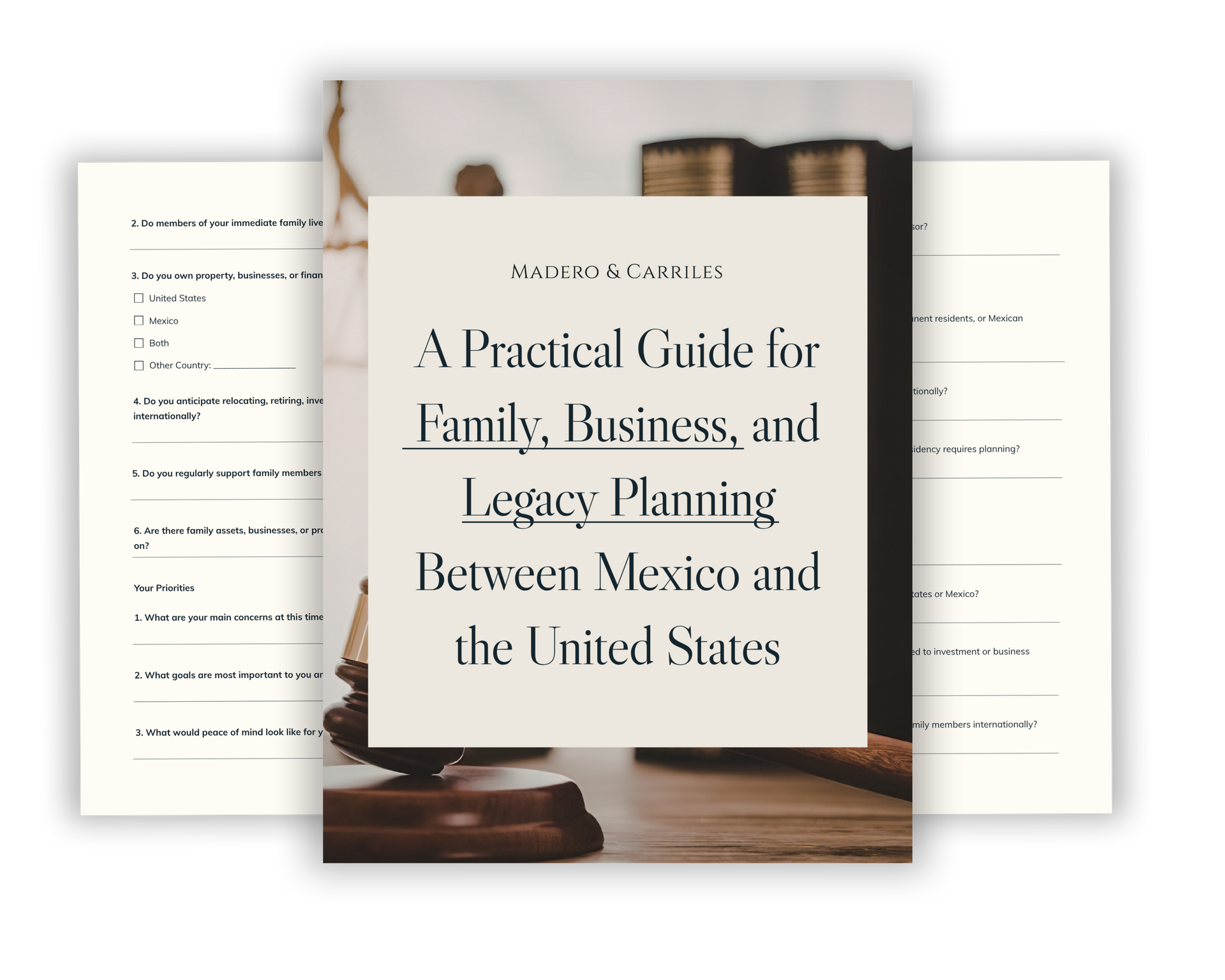
Book a free consultation for your legal matters
Let’s build a legal strategy that supports what matters today and for generations to come.







FAQ
When should I start succession planning?
Ideally, succession planning should begin well before a transition is expected. Early planning provides greater flexibility, improved tax efficiency, and stronger operational stability. Waiting until retirement or a moment of crisis often limits the available options and increases pressure on the business and the family.
What happens to my business if I die?
Without a succession plan, ownership may pass through your estate, which can create probate exposure, tax consequences, and operational uncertainty. A coordinated business succession plan helps ensure continuity and provides clearer guidance for employees, family members, and anyone involved in the future of the company.
How do I transfer a business to my children?
A business may be transferred to children through a range of strategies, including gifting, structured sales, trusts, or staged equity transfers. The appropriate method depends on the value of the business, tax considerations, the readiness of the next generation, and the broader family context. Careful planning helps promote both fairness and legal compliance.
How is a business valued for succession?
Business valuation for succession planning typically takes into account the company’s assets, liabilities, income, market conditions, and industry-specific factors. A professional valuation helps ensure that the transition structure is legally defensible, financially sound, and aligned with applicable tax requirements.
What taxes apply to business transfers?
Depending on the structure of the transfer, business succession may trigger federal estate tax, gift tax, capital gains tax, corporate tax implications, or cross-border tax consequences. Proper legal structuring can often reduce unnecessary exposure while preserving compliance and long-term value.