Cross-Border International Estate & Probate Lawyers | U.S. & Mexico
If you are searching for an international estate planning attorney, your concerns likely extend beyond legal documents. You may be navigating assets in more than one country, planning for children who live across borders, or seeking clarity on how today’s decisions will protect your family’s future for decades to come.
In case you are new here, we are Madero & Carriles, a bilingual and bicultural law firm advising individuals and families in Los Angeles whose assets, property interests, and family relationships often span the United States and Mexico. Many of the estate and probate matters we handle involve cross-border considerations, where effective planning requires coordinating legal systems, property rights, and inheritance rules across jurisdictions.
International estate planning can feel overwhelming because it requires coordination between legal systems that do not automatically align. On this page, we explain what working with an international estate planning attorney involves, the challenges cross-border families often encounter, and how thoughtful, coordinated legal planning can help you move forward with greater clarity and confidence.
What is international estate planning?
International estate planning is the process of structuring your estate so that your assets, family, and long-term legacy are protected across more than one country.
When you work with an international estate planning attorney in Los Angeles, California, the objective extends beyond drafting a will or trust. Effective planning requires coordinating legal documents between the United States and Mexico, understanding how inheritance laws differ across jurisdictions, and evaluating potential estate, gift, and income tax implications.
It also involves structuring the ownership of real estate, financial assets, and business interests in ways that function properly within both legal systems. Without this coordination, families may face conflicting probate or inheritance proceedings that create unnecessary complications for heirs.
Cross-border lives require legal strategies that align systems across jurisdictions. When U.S. and Mexican legal frameworks are not coordinated, unintended legal or tax consequences can arise. Strategic planning helps create clarity, protect long-term wealth, and reduce the risk of costly complications for future generations.
Most common challenges in international estate planning
International estate planning often involves navigating multiple legal systems simultaneously. Managing legal requirements in both the United States and Mexico can create confusion or delay when planning is not properly coordinated.
Many individuals also worry about irreversible legal or financial consequences. Questions frequently arise about triggering unnecessary taxes, unintentionally invalidating a foreign legal document, or leaving family members with administrative complications after death.
Another challenge many cross-border families experience is the lack of culturally aware legal guidance. Explaining the realities of a life that spans two countries can feel exhausting when professionals are unfamiliar with those dynamics.
International estate planning also carries emotional weight. Decisions about legacy, family unity, and financial stability for future generations often involve deeply personal considerations.
How do I know if I need an international estate planning attorney?
You may benefit from working with an international estate planning attorney if your assets, family members, or business interests exist in both the United States and Mexico. In these situations, coordinated planning is often necessary to ensure that legal structures function effectively across jurisdictions rather than relying on isolated documents created in only one country.
Individuals frequently seek international estate planning guidance when they are uncertain how inheritance laws in one country may affect assets located in another. Cross-border legal systems do not automatically align, and assumptions about how one jurisdiction treats property or inheritance can lead to unintended consequences.
Many people also delay planning because the process feels complex. In reality, complexity often reflects a full life involving family, property, and financial responsibilities across borders. Thoughtful legal planning helps bring structure to that complexity.
Clients who pursue international estate planning are often seeking long-term clarity rather than short-term solutions. The goal is to create sustainable legal structures that protect family interests well into the future.
How we approach international estate planning in Los Angeles, California
Our approach to international estate planning combines technical precision in California estate law with strategic coordination between U.S. and Mexican legal systems.
We begin with a comprehensive evaluation of your asset structure across jurisdictions. This often includes reviewing real estate holdings, business interests, financial accounts, and any existing estate planning documents. During this process, we identify potential conflicts between California probate law and Mexican inheritance frameworks, evaluate potential tax exposure, and determine whether parallel legal instruments may be required.
From there, we design a coordinated estate plan that aligns ownership structures, beneficiary designations, and legal documentation across borders. The objective is to create enforceable and administratively practical structures that reduce uncertainty for your heirs and minimize the risk of future disputes.
Throughout the process, we prioritize clarity so that you understand how your assets will transfer, which legal system will govern each asset, and what steps your family will need to take in the future. Our goal is to provide coordinated planning that supports long-term protection across jurisdictions.
What topics can we address within international estate planning attorney services?
International estate planning requires more than drafting documents. It involves coordination, foresight, and understanding how two legal systems interact over time.
Cross border asset coordination
We evaluate how assets are owned and structured in both the United States and Mexico, including real estate, bank accounts, investments, and business interests.
Proper coordination ensures documents across jurisdictions do not conflict. Without alignment, families may face parallel probate proceedings, delays, or restricted access to assets.
Dual will and trust strategy
In cross-border situations, it may be appropriate to establish separate but coordinated wills or trust structures in each country.
These documents must work together without unintentionally contradicting one another. This ensures each asset is governed by the correct legal system while maintaining consistency.
International trust planning and structuring
Trust planning across borders requires evaluating enforceability, reporting obligations, and long-term compliance.
We consider how California trust law interacts with Mexican inheritance principles, how beneficiaries will access assets, and how to minimize long-term tax exposure and disputes.
Estate and inheritance tax exposure analysis
International planning includes evaluating potential U.S. estate tax exposure and cross-border tax implications.
This involves reviewing asset location, residency status, and possible reporting requirements. Early analysis helps reduce unnecessary tax exposure and protect long-term wealth.
Real estate planning across jurisdictions
Cross-border families often hold property in both California and Mexico, each with different inheritance laws and transfer procedures.
We evaluate ownership structures and transfer strategies to ensure property can be transferred efficiently while minimizing delays and complications.
Business succession planning
If you own a business in the United States or Mexico, your estate plan should align with corporate structures.
This may include coordinating ownership transfers, voting rights, and succession strategies to protect both family stability and business continuity.
Heirs residing abroad
When beneficiaries live outside the United States, additional considerations arise, including tax reporting, banking regulations, and access to assets.
Planning ahead helps ensure assets can be distributed efficiently without unnecessary delays or administrative barriers.
Heirship and inheritance law differences
Mexican inheritance law differs from California probate rules, particularly in asset distribution.
Understanding these differences helps prevent unintended outcomes and ensures your wishes are honored across jurisdictions.
Long term legacy and intergenerational planning
International estate planning is not transactional. It is about creating structures that preserve stability, reduce conflict, and protect wealth across generations.
Tips and resources for navigating international estate planning
International estate planning is most effective when approached with coordination and long-term perspective.
Avoid making cross-border decisions based on assumptions. Keep organized records of assets, beneficiaries, and legal documents in both countries.
For individuals with ties to multiple countries, coordinated legal guidance is essential to avoid misalignment and unnecessary complications.
Your trusted law firm in Los Angeles, California
International estate planning attorneys .
At Madero & Carriles, we focus on advising cross-border individuals, families, and business owners navigating complex legal systems in the United States and Mexico with empathy, clarity, and long-term perspective.
Our lived cross-border experience allows us to understand the realities our clients face without requiring them to repeatedly explain their circumstances. We prioritize long-term relationships with the families we serve rather than transactional legal engagements.
When you work with our firm, you receive consistent access to trusted legal counsel and a team that understands the importance of protecting your family, assets, and legacy across generations.

We provide bilingual cross-border estate planning & probate, immigration, and business law services across the U.S. and Mexico. We are in Los Angeles, California, as well as in Mexico City and Guadalajara.
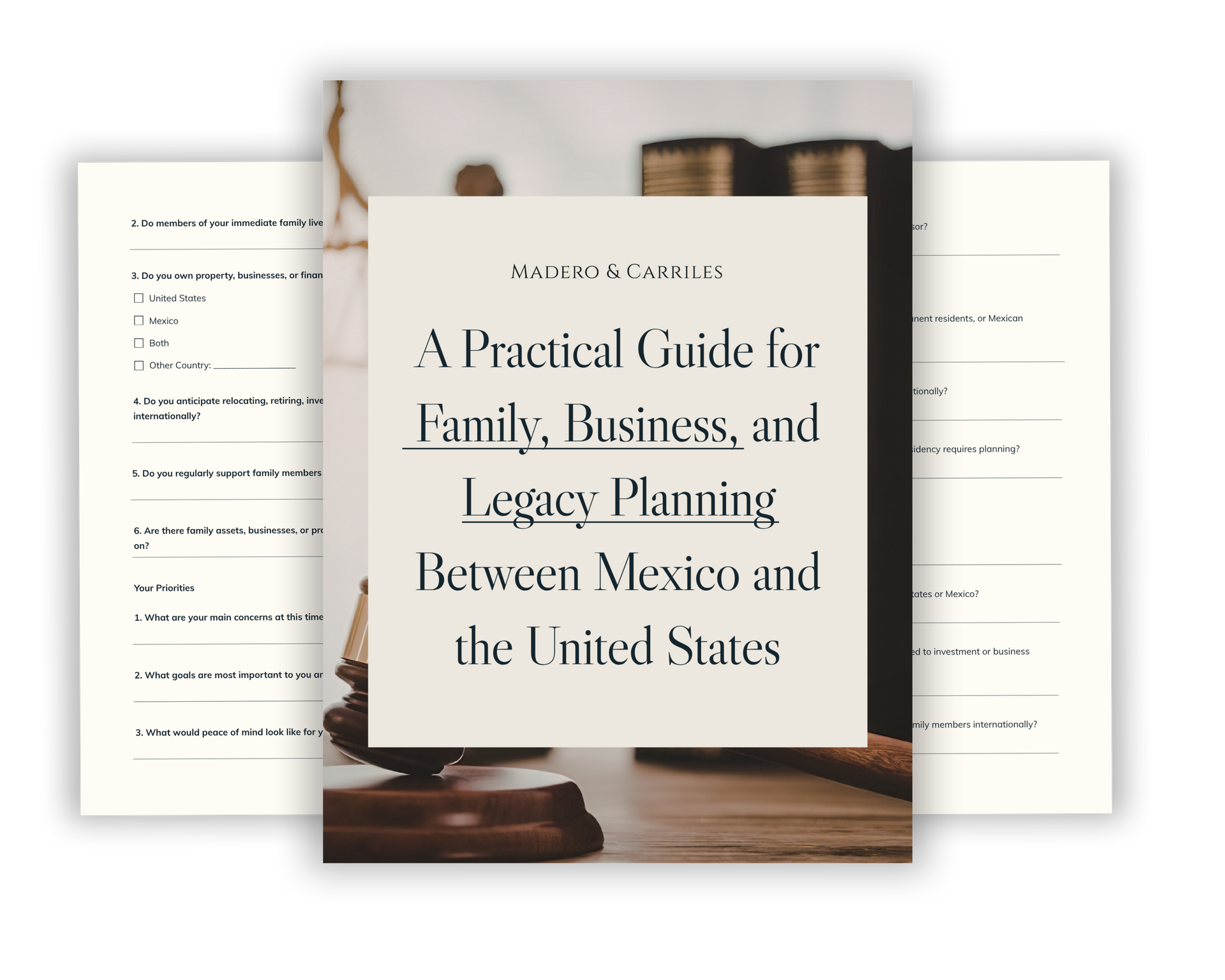
Book a free consultation for your legal matters
Let’s build a legal strategy that supports what matters today and for generations to come.



FAQ
Do I need an estate plan if I own assets in two countries?
Yes. Owning assets in two countries significantly increases legal complexity. Each jurisdiction operates independently. Without coordinated international estate planning, your heirs may face duplicate probate proceedings, conflicting inheritance outcomes, or unexpected tax exposure.
Strategic planning ensures your estate functions as one unified structure rather than fragmented legal pieces.
How are foreign assets taxed after death?
Taxation depends on multiple factors, including asset type, location, and your physical and tax residency at the time of death. U.S. federal estate tax may apply to worldwide assets for U.S. citizens, while Mexico may impose separate inheritance or transfer obligations.
International estate planning evaluates these layers in advance to reduce unnecessary exposure and protect long term family wealth.
Can a U.S. will or trust cover property in Mexico?
In some situations, a U.S. will or trust may address property located in Mexico. However, in many cross-border cases, separate but coordinated estate planning documents are recommended to ensure enforceability under both legal systems.
Carefully drafted documents can complement each other while avoiding unintended revocation or jurisdictional conflicts.
How do inheritance laws differ between the U.S. and Mexico?
California and Mexico operate under different legal traditions. California follows a common law system that allows individuals broad flexibility in deciding how their assets will be distributed. Mexico, by contrast, follows a civil law system with different inheritance structures and legal procedures.
These structural differences make coordinated international estate planning essential for families whose assets or heirs span both jurisdictions.
What happens if heirs live in another country?
When heirs reside outside the United States, additional legal and practical considerations may arise. These can include tax reporting obligations, international banking regulations, currency transfers, and compliance requirements in both jurisdictions.
International estate planning anticipates these realities by evaluating how assets will be accessed, what documentation beneficiaries may need, and how potential administrative delays can be minimized. Planning with beneficiaries’ residency in mind helps create a smoother and more predictable administration process for families.